Capturing the AI upside — what it will actually take
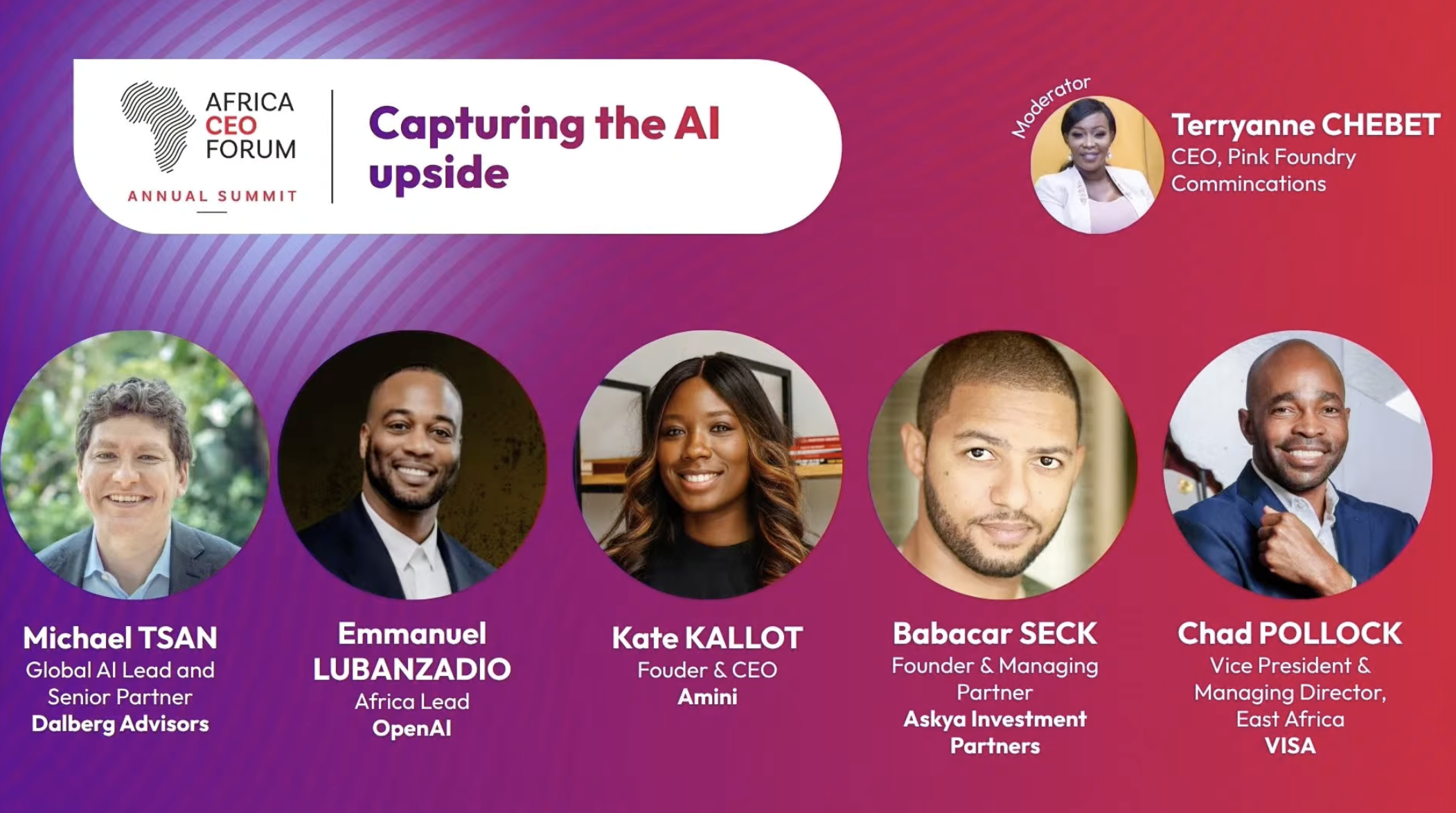
The numbers around AI in Africa are striking enough on their own. Generative AI could generate up to $103 billion in annual economic value across the continent. But as Babacar Seck, our Founder and Managing Partner, pointed out at the Africa CEO Forum in Kigali this May, that figure is probably an underestimate — because it assumes Africa stays where it is today rather than growing into what it is becoming.
At a panel titled "Capturing the AI Upside," Babacar joined Emmanuel Lubanzadio, Africa Lead at OpenAI, Kate Kallot, Founder and CEO of Amini, Michael Tsan, Global AI Lead and Senior Partner at Dalberg Advisors, and Chad Pollock, VP and MD East Africa at Visa, for one of the Forum's most substantive conversations on where AI is heading on the continent and what it will take to get there.
1. The opportunity is bigger than the headline number suggests
Africa is digitizing in the age of AI, and that is a different proposition from what earlier waves of technology offered. Legacy IT systems can be skipped entirely. Data architectures can be built from the ground up to be AI-ready. The digital-native workforce coming into the economy over the next decade is unlike anything the world has seen before.
At Askya, we see the opportunity on two levels. The first is building an African AI stack: localized models and infrastructure that actually serve the continent's contexts, languages and needs rather than treating Africa as an afterthought of systems designed elsewhere. The second is the leapfrog possibility. In two decades the continent went from 50 million bank accounts to over 600 million mobile money users. The same kind of step change is possible in AI, if the right foundations are put in place.
2. The use cases that will scale fastest are demand-driven
The panel converged on a clear point: the AI applications that generate the most value are not the most technically sophisticated ones. They are the ones solving real, felt problems for businesses and people.
Babacar pointed to a company developing AI models that optimize energy efficiency for businesses. In a context where the grid is unreliable and companies depend on solar, batteries and generators, that kind of application delivers 20 to 30% reductions in operating costs. It also unlocks productive capacity, given that some African manufacturers run at 30 to 40% of capacity because of energy constraints. When AI is anchored in productivity and real business pain points, adoption follows naturally. Fintech scaled to hundreds of millions of users not because of the technology alone but because it solved something people genuinely needed. AI will follow the same path.
3. Infrastructure and applications have to grow together
A recurring theme was the false choice between investing in AI infrastructure and investing in applications. We think you need both, and the reason is straightforward. Infrastructure is only financeable if there are applications generating demand for it. And applications can only scale if the infrastructure underneath them is reliable and locally grounded.
Kate Kallot put the gap in stark terms: Africa holds 19% of the world's population but less than 1% of its compute capacity. The answer is not waiting for gigafactories. It is modular, deployable infrastructure that can reach the places that need it. On data, the picture is similar. Only around 2% of global AI training data comes from Africa, not because the data does not exist but because it has not been digitized or made accessible. As Kate noted, much of it is analog, scattered, spoken. Fixing that is foundational work, and it is already underway.
4. Regulation should enable, not constrain
On regulation, the panel was aligned. Africa cannot regulate its way to development. Policy needs a clear objective, and the tools to get there are procurement, technology transfer and investment in research and education.
Babacar was direct on his point that regulation has to work at a regional level. Africa has too many small economies for country-by-country frameworks to allow anyone to scale. If the rules prevent companies from growing beyond a single national market, the ecosystem will not develop.
Michael Tsan added his view that a lot of the regulatory conversations are stuck in the wrong place, focused on copying EU frameworks that were not designed for Africa's context. His argument: you cannot regulate what you cannot measure. The priority should be building Africa-centered benchmarks and evaluations for AI in health, agriculture and safety, grounded in African data. Once you have that measurement layer, sectoral regulation becomes meaningful. Without it, you are regulating in the dark.
Ten years from now, if the work gets done, our view at Askya is that AI will be embedded in every sector of the economy, not as a separate technology layer but as part of how businesses and people operate every day. Africa has the youngest and fastest-growing workforce in the world, and it is digital native in a way no previous generation has been. Combined with the continuous fall in the cost of data and smartphones, the conditions for a genuine step change in productivity and income are in place.
The question is whether investors, builders, governments and global partners move with enough urgency and coordination to make it happen.